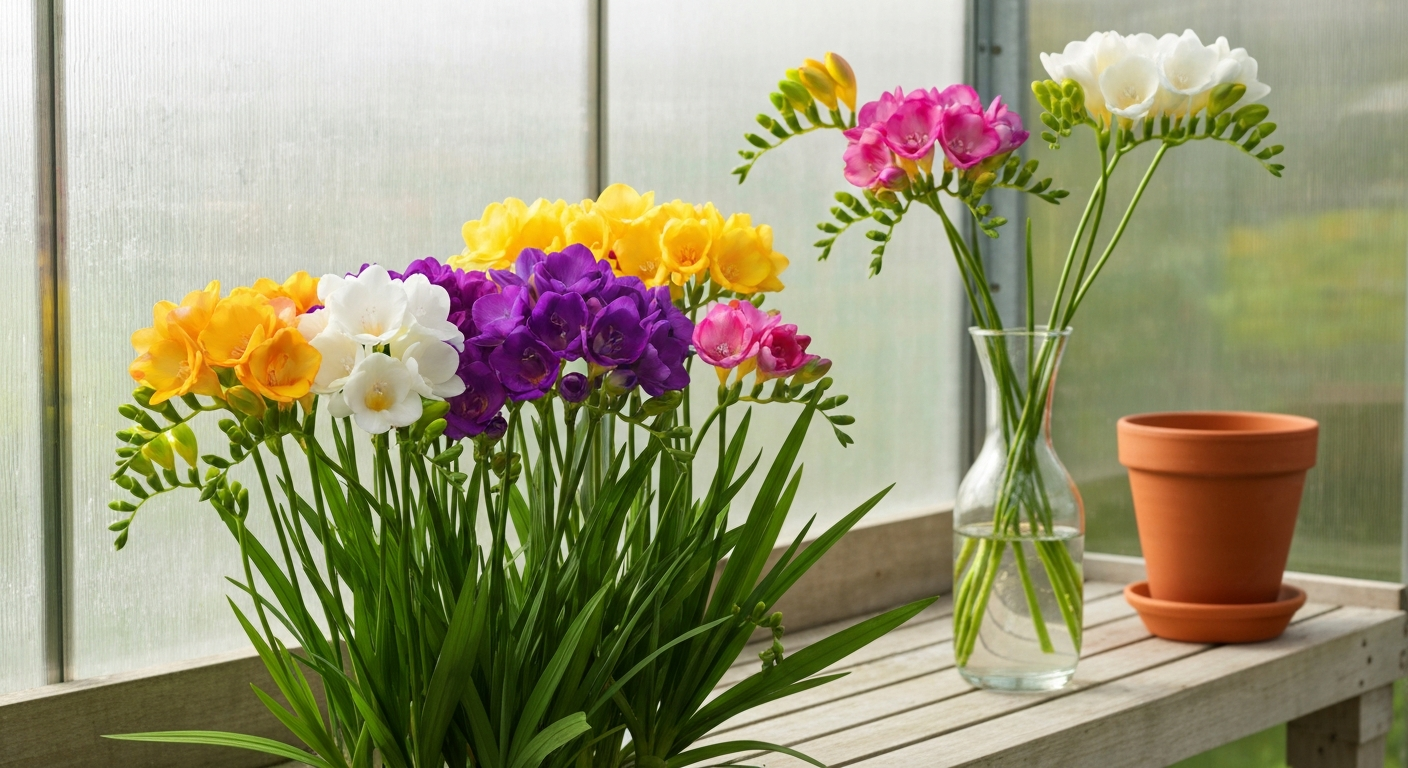
Title: How to Grow Freesias in the UK: A Complete Guide to Corms, Seeds and Timing
How to Grow Freesia UK: A Practical Month-by-Month Guide

Marcus Holloway
22 Jul 2026
Meta description: Learn how to grow freesias in the UK, from planting corms and sowing seed to timing by region, care, troubleshooting and overwintering. Practical advice for beginners.
You can absolutely grow freesias in the UK, and they are worth every bit of effort. Plant prepared (heat-treated) corms in spring for July to August flowers outdoors, or pot up unprepared corms between August and December and force them under glass for blooms as early as January. They do need a little shelter and good drainage, but they are far more manageable than their reputation suggests.
Who this guide is for and what it covers
If you have never grown freesias before and you are not sure where to start, this guide is written for you. It covers everything from choosing between corms and seed, to exact planting windows by UK region, daily care, feeding, staking, and what to do when things go wrong. By the end you will know how to get scented freesia stems from your own garden or pots, and how to store the corms safely each winter so you can do it all again the following year.
Can you grow freesias in the UK? Suitability at a glance
Freesias are native to South Africa, which tells you most of what you need to know about their temperament. They are tender corm-growing plants that can tolerate only a few degrees of frost. That does not make them impossible in the UK, but it does mean you need to match your growing method to your climate. In the mildest parts of southern England and sheltered coastal spots in Wales and Ireland, you can plant corms in a warm, free-draining border and leave them to it through a mild winter. Everywhere else, the safest and most reliable approach is to grow them in pots so you can bring them under cover when temperatures drop. The good news is that freesias genuinely thrive in containers, and growing them in a cool greenhouse, conservatory or even a bright porch is arguably the best way to get the long, perfumed stems they are famous for. Temperatures above around 15°C cause spindly growth and quickly fading blooms, so the cool, often grey UK spring is actually quite well-suited to freesias when you manage them correctly.
Recommended freesia varieties for UK gardens
Most UK nurseries sell mixed-colour corm collections, which are perfectly good for a first attempt. But if you want to choose by colour or type, here are the varieties most likely to reward you in UK conditions.
- 'Alba': pure white, strongly scented single flowers — one of the best for cutting and perfume indoors.
- 'Yellow River': a bold, warm yellow single that performs well in pots and keeps its colour even in lower light.
- 'Royal Blue': deep purple-blue doubles that look spectacular in a vase; doubles generally have a longer vase life.
- 'Pink Marble': a soft pink double with a cream throat, reliable and compact — good for smaller containers.
- 'Oberon': red-orange single with a good fragrance, one of the hardier choices for a sheltered southern border.
- Mixed single collections (such as those sold by Harts Nursery and Peter Nyssen in 6/7 cm and 7+ cm grades): ideal for beginners wanting a range of colour without committing to specific varieties.
Your planting options: outdoor border, pots, sheltered bed and greenhouse
There is no single right way to grow freesias in the UK. Your best option depends on where you live, what outdoor space you have, and whether you are chasing spring blooms or summer colour. Here is how each approach works in practice.
Outdoor border (southern England and very sheltered spots)
In a free-draining, south-facing border in southern England, you can plant prepared corms directly into the ground from mid-April once the soil at 5 to 10 cm depth has reached roughly 10°C. Choose the warmest microclimate you have, the base of a south-facing wall is ideal. Work in plenty of grit if your soil is at all heavy. These plants will flower in July and August. After flowering, if you are in a reliably mild area, you can try leaving the corms in the ground through winter with a thick mulch of dry straw or bark, but lifting them is safer.
Sheltered bed with cloche or fleece protection
In the Midlands, northern England and Wales, a cloche or double layer of horticultural fleece over the bed extends your outdoor season meaningfully. Plant corms in late April to May, cover on cold nights until late May, and you will still get summer flowers. The extra protection also keeps the soil warmer at planting depth and gets shoots away faster.
Pots and containers (the most versatile UK option)
Growing freesias in containers is genuinely the most practical approach for most UK gardeners. You can start earlier, move pots to shelter at short notice, and control the compost mix precisely. Use a pot at least 15–20 cm deep and fill it with two-thirds John Innes No. 2 (peat-free works well) and one-third horticultural grit. This mix drains freely while holding enough nutrition to see the plant through to flowering. For spring-planted pots, keep them outdoors from late April onwards and move them inside if a late frost is forecast.
Greenhouse and forcing for winter and early spring flowers
This is where freesias really shine in the UK. Planting unprepared corms in containers between August and December and managing their temperature gives you blooms from January through to April, the most rewarding freesia experience you can have. The forcing process involves a deliberate cold treatment (around 5°C for three to four weeks) followed by a move to a cool greenhouse or conservatory at 10–15°C. Full details are in the step-by-step section below.
Exact timing by month and UK region
The table below summarises when to sow seed, plant corms, force for winter flowers, and when to expect blooms, broken down by region. These timings are based on practical soil temperature triggers and established UK growing guidance. Southern England means roughly south of the Midlands; northern England covers Yorkshire, Lancashire and the Lake District; Scotland and Northern Ireland share broadly similar cautious timing.
| Task | Southern England | Wales & Midlands | Northern England | Scotland & NI |
|---|---|---|---|---|
| Plant prepared corms outdoors | Mid-April | Late April | May | Mid-May to early June |
| Plant corms in pots (outdoors) | Late March to April | April to May | May | Late May |
| Pot up corms for greenhouse forcing | Aug–Dec | Aug–Dec | Aug–Dec | Aug–Dec |
| Cold treatment (5°C stage) | 3–4 weeks after planting | 3–4 weeks after planting | 3–4 weeks after planting | 3–4 weeks after planting |
| Move to cool greenhouse (10–15°C) | After cold treatment | After cold treatment | After cold treatment | After cold treatment |
| Outdoor flowering window | July–Aug | July–Aug | Aug–Sept | Aug–Sept |
| Forced/greenhouse flowering | Jan–April | Jan–April | Jan–April | Jan–April |
| Sow seed (indoors, heated) | Feb–April | Feb–April | March–April | March–April |
| Lift corms after foliage dies | Sept–Oct | Sept–Oct | Aug–Sept | Aug–Sept |
For succession planting to extend your cut-flower supply, plant a new batch of corms every two to three weeks from March through to June (in pots or under glass). Each batch flowers roughly 10 to 12 weeks after planting, so staggered plantings give you stems across the whole summer.
Sowing from seed vs planting corms: which should you choose?
Most UK gardeners grow freesias from corms, and for good reason. Corms flower in their first season (10–12 weeks after planting), they are widely available, and the process is straightforward. Growing from seed is a longer-term project: expect seedlings to take several months to appear and then multiple years before they reach flowering size. The honest answer is that seed is really for enthusiasts who want to try unusual colours or run a breeding project, not for someone who wants flowers this summer.
| Factor | Corms | Seed |
|---|---|---|
| Time to flower | 10–12 weeks | Several years |
| Difficulty | Easy | Moderate to tricky |
| Cost | Moderate (usually sold by weight/grade) | Low per packet |
| Variety range | Good — many named varieties available | Limited named varieties; often sold as mixed |
| Pre-treatment needed | Cold treatment for forcing only | 24-hr warm water soak + bottom heat at 13–18°C |
| Best for | Beginners, cut flowers, this season | Patient growers, experimenting with unusual colours |
| Germination time | N/A | Several months in dark with bottom heat |
| Forcing possible? | Yes — August to December planting for Jan–April blooms | Not in same season |
If you do want to try seed, soak it in warm water for 24 hours before sowing, then sow into moist seed compost and keep the tray in the dark with bottom heat at 13–18°C (55–64°F). Germination can take anything from a few weeks to a few months, so patience is genuinely non-negotiable. Once germinated, treat seedlings like young corm-grown plants in terms of light and temperature.
Step-by-step: how to grow freesias from corms
This is the method I recommend for anyone new to freesias. It covers spring planting for summer flowers. For the greenhouse forcing method, follow steps 1–4 then pick up at the forcing protocol below.
- Choose your corms: buy from a reputable UK supplier such as Peter Nyssen or Harts Nursery and look for corms graded 6/7 cm or 7+ cm — larger corms produce stronger stems and more flowers. Discard any that feel soft, show blue-grey mould, or have obvious rot.
- Prepare your container or bed: for pots, mix two-thirds John Innes No. 2 with one-third horticultural grit and fill to within about 7 cm of the rim. For borders, dig in a generous amount of horticultural grit if your soil is heavy or slow-draining.
- Plant at the right depth and spacing: set corms with the pointed tip facing upward, 5 cm (2 in) deep in the ground or just at the surface of the compost in a pot. Space corms 5–8 cm apart in pots (up to 10 cm for in-ground plantings where you want larger plants).
- Water in gently: give the compost or soil a thorough but gentle watering after planting. Do not waterlog — freesias are extremely prone to rot if they sit in wet conditions.
- Position in full sun with good ventilation: freesias need at least six hours of direct sun a day. Avoid overcrowded spots where air cannot move freely, as still, humid air encourages botrytis (grey mould).
- Support as shoots grow: freesia stems are naturally floppy. Push in thin bamboo canes or use a wire hoop support around the pot early, before the stems lean. Tying stems loosely with soft twine to a cane as they grow prevents damage.
- Water consistently once in active growth: keep the compost evenly moist but never waterlogged. In dry spells, water every two to three days. Stop watering once the foliage starts to yellow after flowering.
- Start feeding when the first buds appear: apply a high-potassium liquid feed (tomato feed or Phostrogen work well — Phostrogen has an approximate N-P-K of 16-4.4-19.9) every two weeks from bud stage until flowering ends. This is the single most effective thing you can do for stem quality and scent.
- Deadhead spent blooms but leave the foliage: snip off individual faded flowers as they go over, but leave all the green leaves in place. The foliage feeds the corm and helps it build strength for next year — you need at least six to eight weeks of leaf growth after flowering finishes.
- Only remove foliage when it turns yellow or brown: cutting back green leaves early is the most common mistake beginners make. Wait until the leaves are genuinely yellow or brown before removing them.
Greenhouse forcing protocol (for January to April blooms)
- Between August and December, plant unprepared corms into the gritty compost mix described above, with corm tips just at the compost surface.
- Water lightly, then place the pots in a cool, frost-free spot — an unheated shed, garage, or cool porch — and maintain a temperature of around 5°C for three to four weeks. This cold treatment mimics the natural dormancy break the corm needs.
- After the cold treatment, move pots into a cool greenhouse or conservatory where the temperature sits between 10°C and 15°C. Make sure there is good light and ventilation.
- Keep this temperature range consistent throughout the growing and flowering period. Temperatures above 15°C cause spindly growth, rapid fading of flowers, and sometimes deformities — a cool, bright environment is the key to long-stemmed, fragrant blooms.
- Water and feed as described above once active growth begins.
Step-by-step: sowing freesias from seed
This is a longer route but genuinely satisfying if you enjoy the process. Be realistic: you are planting for flowers in future years, not this season.
- Start with fresh seed from a reliable UK supplier. Older freesia seed has poor germination rates.
- Soak the seed in a cup of warm (not hot) water for 24 hours before sowing. This softens the seed coat and speeds up germination.
- Fill a small pot or module tray with fine seed compost, firm it gently, and water it before sowing so the surface is evenly moist.
- Sow seeds individually on the surface, about 2–3 cm apart, then cover with a very thin layer of fine compost or vermiculite (about 3–5 mm).
- Cover the pot with black polythene or place it inside a dark cupboard. Freesia seed germinates best in the dark at 13–18°C (55–64°F). A heated propagator is ideal.
- Check every few days. Germination is slow and variable — you may see nothing for several weeks. Do not give up before two to three months have passed.
- Once seedlings emerge, move the pot immediately to a bright, cool spot (10–15°C). Leaving germinated seedlings in the dark will cause etiolated, weak growth.
- Pot on into the gritty John Innes No. 2 mix when seedlings are large enough to handle, and grow on exactly as you would corm-grown plants from this point — though expect several growing seasons before they flower.
Soil, light, water and feeding: the daily care basics
Below is a quick-reference care table covering the key growing parameters. These numbers are based on RHS guidance and standard UK nursery specifications. RHS recommends applying a high‑potassium feed (for example Phostrogen or a tomato feed) every two weeks once the first buds appear; Phostrogen’s typical N‑P‑K is about 16–4. High‑potassium tomato/flowering feeds (for example 4‑1‑8 or Phostrogen’s typical N‑P‑K around 16‑4‑20) are commonly recommended for the bud/flower stage; always follow pack instructions for dilution and application frequency blank" rel="noopener noreferrer">High‑potassium tomato/flowering feeds (for example 4‑1‑8 or Phostrogen’s typical N‑P‑K around 16‑4‑20) are commonly recommended for the bud/flower stage; always follow pack instructions for dilution and application frequency.. 4–19.9 blank" rel="noopener noreferrer">How to grow freesias / RHS Growing Guide (watering & feeding).
| Parameter | Requirement | Notes |
|---|---|---|
| Planting depth (corms) | 5–7 cm | Tip just at surface in containers; 5 cm in ground |
| Spacing | 5–8 cm (pots), up to 10 cm (ground) | Closer spacing fine in containers |
| Light | Full sun, min. 6 hours | South-facing position ideal; ventilation essential |
| Watering (active growth) | Evenly moist, never waterlogged | Stop watering when foliage yellows |
| Temperature during growth | 10–15°C | Above 15°C causes spindly growth and fading |
| Feeding | High-K liquid feed every 2 weeks from bud stage | Tomato feed or Phostrogen; follow pack dilution |
| Bloom time (outdoor, corms) | 10–12 weeks after planting | July–Aug in most of UK |
| Bloom time (forced/greenhouse) | Jan–April | Depends on planting date Aug–Dec |
| Compost mix (containers) | 2/3 John Innes No. 2 + 1/3 horticultural grit | Peat-free JI works well |
| Corm grade (recommended) | 6/7 cm or 7+ cm | Larger = stronger stems and more flowers |
Staking: don't skip this
Freesias are floppy by nature and will sprawl without support. I always put canes in at planting time rather than waiting for the stems to flop, by the time you notice they need it, they are already bent at a point that will never fully straighten. Thin bamboo canes about 30–40 cm tall, placed one per 4–5 corms, with soft twine in a loose loop, is all you need. Wire hoop supports sold for herbaceous plants also work beautifully in larger containers.
Common problems and how to fix them
Freesias are not particularly trouble-prone, but a handful of issues come up reliably in UK growing conditions. Here is what to look for and what to do.
| Problem | Likely cause | What to do |
|---|---|---|
| Soft or rotting corms before or after planting | Waterlogged soil or 'blue mould' in storage | Improve drainage; store corms dry; discard affected ones |
| No shoots after 6–8 weeks | Corms too cold, rotted, or planted upside down | Check corms; ensure pointed tip faces up; verify soil temp ≥10°C |
| Spindly, weak stems | Temperature too high (above 15°C) | Move to cooler, well-ventilated spot; avoid over-heating greenhouse |
| Flowers fade quickly | Excessive heat or waterlogging | Keep at 10–15°C; ensure roots are not sitting in water |
| Grey mould (botrytis) on leaves or flowers | Humid, still air — common in UK autumns | Improve ventilation; remove affected material promptly; avoid overhead watering |
| Aphids on young shoots | Common in late spring and early summer | Squash by hand or use a soap spray; check undersides of leaves |
| Red spider mite (greenhouse plants) | Hot, dry conditions; lack of humidity | Increase ventilation and mist paths (not leaves); use biological control |
| Slugs and snails damaging shoots | Wet conditions, especially outdoor plants | Copper tape around pots; organic slug pellets; check at night |
| Mice eating corms | Freshly planted, especially in autumn/winter | Set traps near pots; place pots on staging off the ground |
| Flower deformities or streaked leaves | Plant virus | No cure; remove and dispose of affected plants; do not replant in the same spot |
Cutting your freesias and getting the best vase life
Cut freesia stems in the morning when the first one or two flowers on the spike are just opening, the remaining buds will continue to open in the vase. Use clean, sharp scissors or snips and cut at a long diagonal to increase the stem's water uptake surface. Place stems immediately in cool water in a clean vase. Freesias last up to seven to ten days in the vase when cut at this stage, kept in a cool room away from direct sun and topped up with fresh water every day or two. Adding a pinch of sugar and a drop of bleach to the water helps too. Remove spent individual blooms as they go over to keep the arrangement looking fresh while the remaining buds open.
Lifting, curing and storing corms for winter
Once the foliage has turned genuinely yellow or brown, at least six weeks after the last flowers have finished, ideally eight, it is time to lift your corms. Ease them out carefully with a hand fork to avoid splitting off the offsets (small cormlets attached to the parent). Shake off the soil and lay the corms on a tray in a warm, airy place to dry for a couple of weeks.
Here is the part most guides skip over: for the corms to reset for next year, they need a warm dry cure. The RHS recommends storing lifted freesia corms dry at around 26°C with 75–80% relative humidity for 14 to 20 weeks. In practice, a warm airing cupboard or the top of a boiler cupboard in a paper bag (never plastic, plastic traps moisture and causes rot) comes close enough. After the warm storage period, move them to a cooler, frost-free place until planting time the following spring.
Inspect corms before storing and discard any showing blue-grey mould (Penicillium, the 'blue mould' of warm, moist storage), soft spots, or signs of Sclerotinia. Healthy stored corms will feel firm and dry.
Where to buy freesia corms and seed in the UK
For corms, Peter Nyssen and Harts Nursery are both reliable UK mail-order bulb suppliers with good variety selections and clearly graded stock, look for 6/7 cm or 7+ cm grades, which produce notably better results than smaller grades. Suttons Seeds and Sarah Raven also carry freesia corms seasonally. For seed, Thompson & Morgan and Chiltern Seeds stock freesia seed, though variety choice is limited compared to corms. Buying from a specialist UK bulb supplier rather than a general garden centre gives you better provenance and fresher stock, which matters for germination and vigour.
Image suggestions for this guide
- Close-up of freesia corms in a hand, showing the pointed tip and firm texture — caption: 'Good corms feel solid and dry; the pointed tip should face upward when planted.'
- Hands filling a terracotta pot with the John Innes No. 2 and grit mix — caption: 'The two-thirds compost, one-third grit mix drains freely and prevents rot.'
- Freesia shoots emerging in a pot at about 5 cm height, supported by a small bamboo cane — caption: 'Put supports in early — by the time stems are flopping, they are hard to train.'
- A full pot of freesias in flower on a south-facing patio, stems upright and heavily budded — caption: 'Succession planting every 2–3 weeks keeps flowers coming all summer.'
- Freshly cut freesia stems laid on a table beside a vase of water — caption: 'Cut when the first one or two flowers on each spike are just opening for maximum vase life.'
- Lifted corms drying on a tray after foliage dieback — caption: 'Let the foliage die back fully before lifting — at least six weeks after the last flower.'
A few final thoughts
Freesias reward the gardener who pays attention to two things above everything else: drainage and temperature. Get those right and almost everything else falls into place. They are not a difficult flower, they just need growing conditions that suit their South African origins, which means no waterlogging, no excessive heat, and a proper cold treatment if you are forcing them. Start with a bag of 7+ cm mixed corms, a pot of gritty compost, a cool bright window or greenhouse shelf, and you will have cut flowers that will genuinely surprise you. If you enjoy growing similar tender, scented plants in containers, you might also find it worth looking into how to grow pinks, which share many of the same sunny, free-draining preferences and make excellent companions in a cutting garden. See our guide on how to grow pinks (internal ref f30cd498-bd20-4cb9-9eac-61964b538e7c) for growing tips and companion planting ideas. For another companion option in containers, see how to grow magenta plant. If you grow container-scented plants, you might also find guidance on how to grow flaming katy helpful. If you enjoy container-grown scented plants, also see our guide on fuchsia flower how to grow for tips on cultivating fuchsias as attractive companion plants.
FAQ
Are freesias suitable for the UK climate?
Yes — but only with care. Freesias are tender South African corms and do not tolerate hard frost. In the UK they’re best grown in containers, a greenhouse/conservatory, or a very warm, well‑drained, sheltered border. In mild, sheltered southern microclimates they can be left outdoors with winter protection; elsewhere lift and store corms for winter (RHS guidance).
Which freesia varieties do you recommend for UK gardens?
Choose varieties bred for reliable stems and fragrance: 'Double Mixed' (double, showy flowers), 'Single Mixed' (classic single blooms), 'Alba' (white), and named modern single varieties such as 'Solomon' or retailer mixes graded 6/7 cm+. For cutting, pick single‑flower varieties for longer vase life. Buy corms graded 6–7 cm or larger for best flowering (UK nurseries list sizes and suitability).
What planting options work in the UK (outdoor bed, sheltered bed, pots, greenhouse)?
- Pots/containers: best and most reliable; move to frost‑free place for winter or lift corms. - Greenhouse/conservatory: excellent for staged forcing and extended flower windows. - Sheltered raised bed: acceptable in the south if soil is very free‑draining and you can protect from frost. - Open garden beds: only in the warmest, well‑drained, sheltered microclimates and with winter lifting recommended.
Should I sow freesias from seed or plant corms? Which is quicker?
Planting corms is far quicker and recommended for beginners: corms flower in the first season (if prepared/forced). Seed is possible but slow — seed can take months to germinate and several years to reach flowering size. Use seed only if you want to breed varieties or don’t mind waiting.
When should I plant freesias in the UK (month‑by‑month and by region)?
Practical UK timing (general): - For spring/summer outdoor/containers (natural season): plant prepared corms March–June in southern England; wait until April–May in northern England and May in Scotland when soil ≈10°C. - For forcing in greenhouse/indoors: plant August–December and give cold treatment (≈5°C for 3–4 weeks) then grow at 10–15°C to flower January–April. - For overwintered unprepared corms: plant late summer (Aug–Sept) in mild southern sites to remain in ground and flower next spring. Stagger planting every 2–3 weeks for continual blooms.
How do I plant corms (depth, spacing, potting mix, and step‑by‑step)?
Step-by-step for corms (containers or bed): 1) Choose corms graded 6–7 cm or larger. 2) Use free‑draining compost: two‑thirds John Innes No.2 (or equivalent peat‑free) plus one‑third horticultural grit for pots; improve garden soil with grit/sand. 3) Plant corms 5 cm (2 in) deep and about 5–8 cm (2–3 in) apart; in pots place tips just below the surface if forcing. 4) Water gently after planting. 5) For forced pots give a cool 3–4 week pretreatment at ≈5°C (see RHS). 6) Move to cool, bright position (10–15°C) once shoots appear. Follow regular watering and feeding.
Next Article
How to Grow Marigold From Stem Cutting: Step-by-Step
Learn how to grow marigold from stem cuttings, root in water or soil, avoid rot and mold, and transplant to flower.